
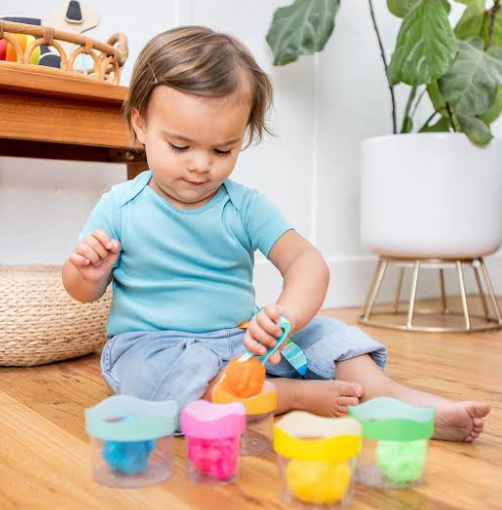
Engaging young minds through hands-on activities is a hallmark of the Montessori method, and one of the simplest yet most versatile tools available is the pom pom. These colorful and fluffy balls provide an array of opportunities for learning and exploration! In this blog post, we’ll dive into a variety of Montessori activities that make use of pom poms, boosting fine motor skills, creativity, and cognitive development.
1. Fine Motor Skills Development
One of the primary benefits of using pom poms in Montessori activities is the enhancement of fine motor skills. Children can engage in simple tasks such as picking up pom poms using tweezers or small tongs. This action not only improves their grasp but also strengthens the small muscles in their hands, laying the groundwork for later skills like writing and self-feeding.
Another engaging activity is the “pom pom drop,” where children can drop pom poms from varying heights into a container. This helps them refine their hand-eye coordination while simultaneously learning about cause and effect. Activities like these can be easily modified in terms of difficulty by introducing different gripping tools or containers with varying sizes of openings.
-
- Use colorful tweezers or tongs for gripping activities.
-
- Introduce pom poms of different sizes for added challenge.
-
- Use a transparent container so children can visually track their successes.
-
- Incorporate a timer to make the activity competitive and exciting.
-
- Encourage older children to create patterns while using pom poms.
2. Color Recognition and Sorting Skills
Pompoms can also serve as an excellent tool for teaching color recognition and sorting. By providing a variety of colored pom poms, you can create sorting games where children categorize them based on hues. For instance, laying out a color chart and asking children to match the pom poms with the corresponding colors can be both fun and informative.
Additionally, mixing pom poms into multiple containers allows children to practice sorting by color. This reinforces their understanding of color while enhancing their organizational skills. You can further challenge them by adding a step where they sort by temperature, distinguishing between “warm colors” (reds and yellows) and “cool colors” (blues and greens).
-
- Set out a color wheel for reference while sorting.
-
- Create a point system for correctly matched colors.
-
- Introduce a “mystery color” where children guess what color comes next.
-
- Encourage them to explain their sorting method for better understanding.
-
- Incorporate discussions about the colors found in nature.
3. Creative Arts and Craft Projects
Beyond academic learning, pom poms are excellent for fostering creativity and artistic expression. Children can use them to create unique art pieces, such as pom pom animals or colorful collages. By gluing pom poms on paper, children can explore textures, colors, and shapes, which can ignite their imaginations.
Another captivating craft can involve making a pom pom garland. By threading pom poms onto a string, children can practice their threading skills while creating a beautiful decoration for their personal space. This activity nurtures patience and gives a sense of accomplishment as they see their creation come together.
-
- Use non-toxic glue for safety in arts and crafts.
-
- Encourage children to plan their project layout before starting.
-
- Provide tools like needles or strings specifically designed for kids.
-
- Incorporate themes, such as seasons or holidays for added context.
-
- Display their finished works to boost their confidence.
4. Counting and Math Concepts
Pompoms can be simplified yet effective tools for introducing counting and basic math concepts. Children can engage in activities where they count pom poms in groups, making it a fun way to practice numbers. For example, you can set up challenges where they need to add or subtract pom poms based on given scenarios, nurturing an early interest in math.
Moreover, using pom poms for basic pattern-making allows children to grasp sequencing. By arranging them in varying orders, children can visually understand concepts like “more than” or “less than,” fostering foundational math skills. The tactile experience of manipulating pom poms deepens their engagement with mathematics.
-
- Start with simple counting exercises using a fixed number of pom poms.
-
- Incorporate games that require them to “catch” a certain number of pom poms.
-
- Challenge them to create addition/subtraction problems with visual aids.
-
- Encourage friends to work together to solve pom pom-based math tasks.
-
- Use pom poms in different colors to visualize different groups.
In conclusion, Montessori activities with pom poms are a fantastic way to combine fun with valuable learning opportunities. Whether you’re enhancing fine motor skills, teaching color recognition, fostering creativity, or introducing math concepts, pom poms are versatile tools that can enrich any educational environment. Why not incorporate some of these activities into your routine today and watch as the young learners in your life thrive?