
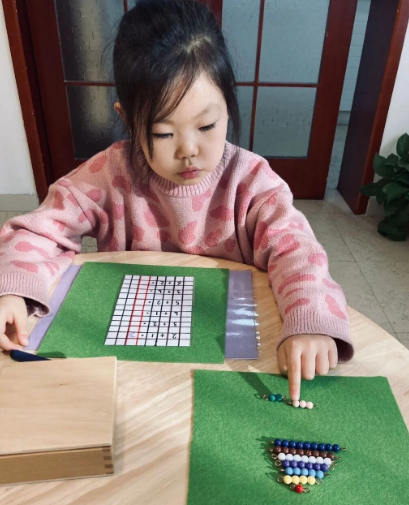
Montessori activities can be vibrant and effective, especially when using colorful beads. These engaging materials not only captivate children’s attention but also enhance their fine motor skills, promote concentration, and support mathematical learning. In this blog post, we will explore various Montessori activities with beads that can enrich your child’s learning experience.
1. Counting and Sorting with Beads
One of the simplest yet most effective uses of beads in a Montessori setting is to practice counting and sorting. Children can use different colored beads to count, group, and compare quantities. For example, you can provide a bowl of mixed beads and ask your child to sort them by color or size. This hands-on activity not only strengthens their mathematical understanding but also develops their organizational skills.
To take the counting activity a step further, you can encourage your child to create patterns using the beads. For instance, they may arrange beads in sequences, alternating colors or sizes, which promotes logical thinking and symmetry. These activities can be tailored to various skill levels, making them perfect for a range of ages.
-
- Gather various colored beads and bowls for sorting.
-
- Encourage your child to count and categorize beads by color.
-
- Introduce patterns for older children to challenge their thinking.
-
- Use a chart to track the number of each color sorted.
2. Bead Stringing for Fine Motor Skills
Bead stringing activities are fantastic for enhancing fine motor skills in young learners. Children can develop hand-eye coordination as they manipulate smaller beads to thread onto strings. This activity is particularly beneficial for toddlers who are just beginning to refine their motor skills, making it a foundational Montessori exercise.
To diversify this activity, you can introduce various string types, such as yarn or elastic thread, and different bead sizes. This will not only keep your child engaged but also allow them to explore different textures and weights. You can encourage creativity by having them create necklaces, bracelets, or even art pieces that they can proudly display.
-
- Choose a range of beads with varying sizes and shapes.
-
- Provide different types of strings for your child to practice threading.
-
- Encourage creativity by having your child design their own jewelry.
-
- Set challenges like threading a specific number of beads.
3. Mathematical Concepts and Bead Work
Beads can serve as an excellent tool for introducing mathematical concepts, such as addition, subtraction, and even multiplication. Using a bead frame or a simple string of beads, children can visualize equations by physically moving beads to represent numbers. This tactile approach helps in solidifying abstract concepts into something tangible.
For example, you could start with simple addition by having your child add beads together from separate piles, physically moving the beads to form new groups. As they progress, introduce more complex concepts like skip counting, which could lead to an understanding of skip counting by twos, fives, or tens using groups of beads. This fun and engaging way of learning fosters a love for mathematics.
-
- Utilize a bead frame or string beads to help visualize equations.
-
- Start with simple addition and gradually increase complexity.
-
- Encourage skip counting using different colored bead groups.
-
- Incorporate measurement by counting lengths of bead strings.
4. Bead Art for Creative Expression
Creative expression is an essential part of a child’s development, and bead art allows children to explore their imaginative side. Using beads as a medium for art projects can be a delightful way to merge creativity with learning. Children can use beads to create patterns and designs on canvas, paper, or even in 3D form.
To encourage their artistic flair, set up a dedicated bead art area with various beads, glue, and other craft supplies. Whether they choose to make a collage with beads arranged into shapes or a three-dimensional sculpture, the possibilities are endless. This activity not only hones their creativity but also enhances spatial awareness as they visualize their designs.
-
- Provide various art supplies alongside beads for creative projects.
-
- Encourage your child to create art pieces in different styles.
-
- Allow for free expression, letting them choose colors and shapes.
-
- Discuss their creations to enhance language skills.
In conclusion, incorporating beads into Montessori activities can create a rich and engaging learning environment. These activities not only foster essential skills but also promote creativity and curiosity in children. You can easily integrate these activities into your daily routine, helping to support your child’s development in a fun and effective way.