
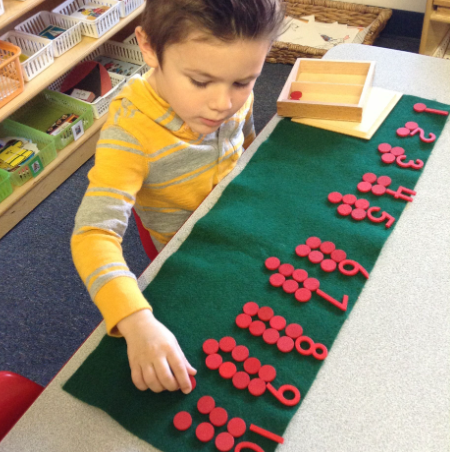
Montessori math activities can transform learning into a fun and engaging experience for kids. By incorporating hands-on elements, children can build a strong foundation in mathematical concepts while exploring at their own pace. Here we explore several effective Montessori math activities that you can integrate into your child’s learning routine.
1. Sensorial Counting with Beads
One of the cornerstones of Montessori math is using concrete materials, and bead activities are a wonderful example. Children can start with simple bead strings, where each bead represents a number. As they manipulate and count the beads, they gain a hands-on understanding of quantities and number relationships. For instance, you could have them create patterns using different colored beads, boosting their visual and mathematical skills simultaneously.
Moreover, as they progress, they can explore operations like addition and subtraction by combining and separating beads. For example, if they have ten beads and remove three, they’d have to count the remaining beads to understand the concept of subtraction. This tactile approach allows children to visualize numbers and develop a deeper comprehension of basic math operations.
-
- Gather different colored beads for a variety of activities.
-
- Encourage children to create patterns with the beads.
-
- Use a mat to organize the beads for clearer spatial understanding.
-
- Guide them through simple math operations using beads.
-
- Introduce larger quantities gradually as they master smaller ones.
2. Nature-Inspired Math Games
Nature is a rich resource for math learning, and it provides unique opportunities for engaging activities. You can take your children outdoors to collect items such as leaves, stones, or flowers, and then use these to teach counting, sorting, or even simple measurement. For example, ask your child to gather ten leaves and then classify them by size or color, which encourages observation and enhances their categorization skills.
Additionally, you can incorporate measuring by using natural objects. For instance, create a small “nature ruler” using a stick, and help them measure how long various objects are. This activity not only reinforces mathematical principles but also fosters a connection to the environment, making learning more meaningful.
-
- Take nature walks and gather various natural items.
-
- Introduce classification by size, shape, or color.
-
- Engage in measuring activities using collected items.
-
- Encourage creativity by having them create nature-inspired art.
-
- Discuss the properties of different items they find.
3. Practical Life Skills with Math
Incorporating math into daily life activities is a vital aspect of the Montessori approach. Simple tasks like cooking or grocery shopping can be turned into excellent math learning opportunities. For example, ask your child to measure ingredients using cups and spoons. Not only will they practice their measuring skills, but they’ll also learn about fractions and volume in a practical context.
Moreover, during grocery shopping, involve your child in budgeting and counting money. Hand them a certain amount of money and have them keep track of expenses while you shop. This gives them a real-world application for addition and subtraction, as well as an awareness of financial literacy from a young age.
-
- Choose a recipe that requires multiple measurements.
-
- Involve children in planning meals to develop budgeting skills.
-
- Use coupons or sale ads to teach about discounts.
-
- Encourage them to help with setting the dinner table for counting practice.
-
- Discuss the importance of saving while managing a budget.
4. Exploring Geometry through Art
Geometry can sometimes seem abstract, but when introduced through art, it becomes accessible and exciting. You can set up a creative space with materials such as clay, colored paper, and string. Encourage your kids to create different shapes and explore their properties. For example, have them create a square using string or model various shapes using clay, discussing their attributes as they work.
Additionally, art allows for a fusion of creativity and math. Once they become familiar with basic shapes, you can progress them to more complex concepts like symmetry and angles by creating designs that involve these elements. This hands-on approach to geometry makes the subject less daunting while enhancing their critical thinking skills.
-
- Provide various art supplies for creative exploration.
-
- Challenge them to create a project using only geometric shapes.
-
- Discuss the properties of shapes as they create.
-
- Introduce concepts like symmetry using mirrors.
-
- Encourage them to collaborate on larger projects to enhance teamwork.
Incorporating Montessori math activities into your child’s routine can ignite a long-lasting love for learning. By utilizing hands-on, practical experiences, children not only grasp mathematical concepts but also engage in critical thinking and problem-solving. Start with one or two activities today, and watch as they flourish in their understanding of math!